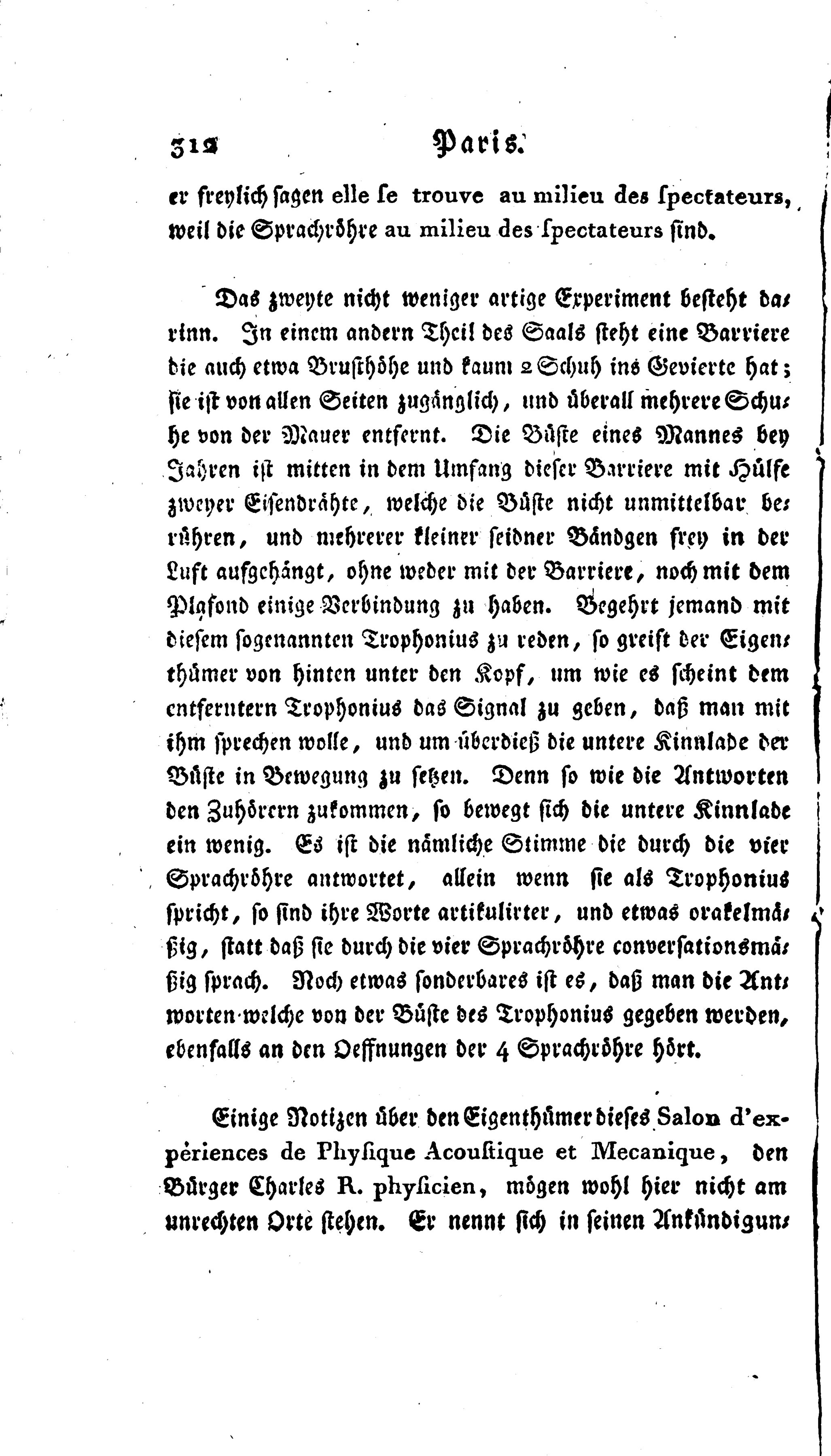
Experimente der Unsichtbarkeit und des Trophoniuskopfes im Maison Longueville. Anecdoten von Carl Rony, dem Unternehmer
London und Paris, N. 4, Vol. 5, Industrie-Comptoir, Weimar july 1800, pp. 308-315.
1 volume available
A follow-up Paris letter in the fourth number of London und Paris (1800) surveys the imitators of Laurent's invisible woman: Robertson, the Paphos dance garden and, from 3 Prairial (23 May 1800), the salon in the Maison Longueville. A footnote reports that Laurent, now in place Thionville (place Dauphine), raged against his rivals and against the author of the pamphlet exposing his secret, announced a "Voyage de la femme invisible" to the provinces, and was said to have sold the secret. The writer describes the glass globe hung on silk ribbons with four copper speaking trumpets, the invisible girl who talks, plays the piano and sings, and the talking bust of Trophonius, quoting the owner's printed programme. He then gives hostile anecdotes about the owner, "Charles R.", whose real name is given as "Rony" (Charles Rouy): a fortune-teller using a speaking tube in public squares before the Revolution, a Jacobin jailed at Saint-Lazare under the Terror, then a card-reader. In a postscript the editor calls the trick old and well known, citing Halle and Funk, Philostratus on the oracular head of Orpheus, the 1784 London pamphlet on the speaking figure, a Nuremberg treatise on speaking machines (1798), Nicolai and Kempelen. Full transcription and Italian translation.
Language
German
