Thomas Moore
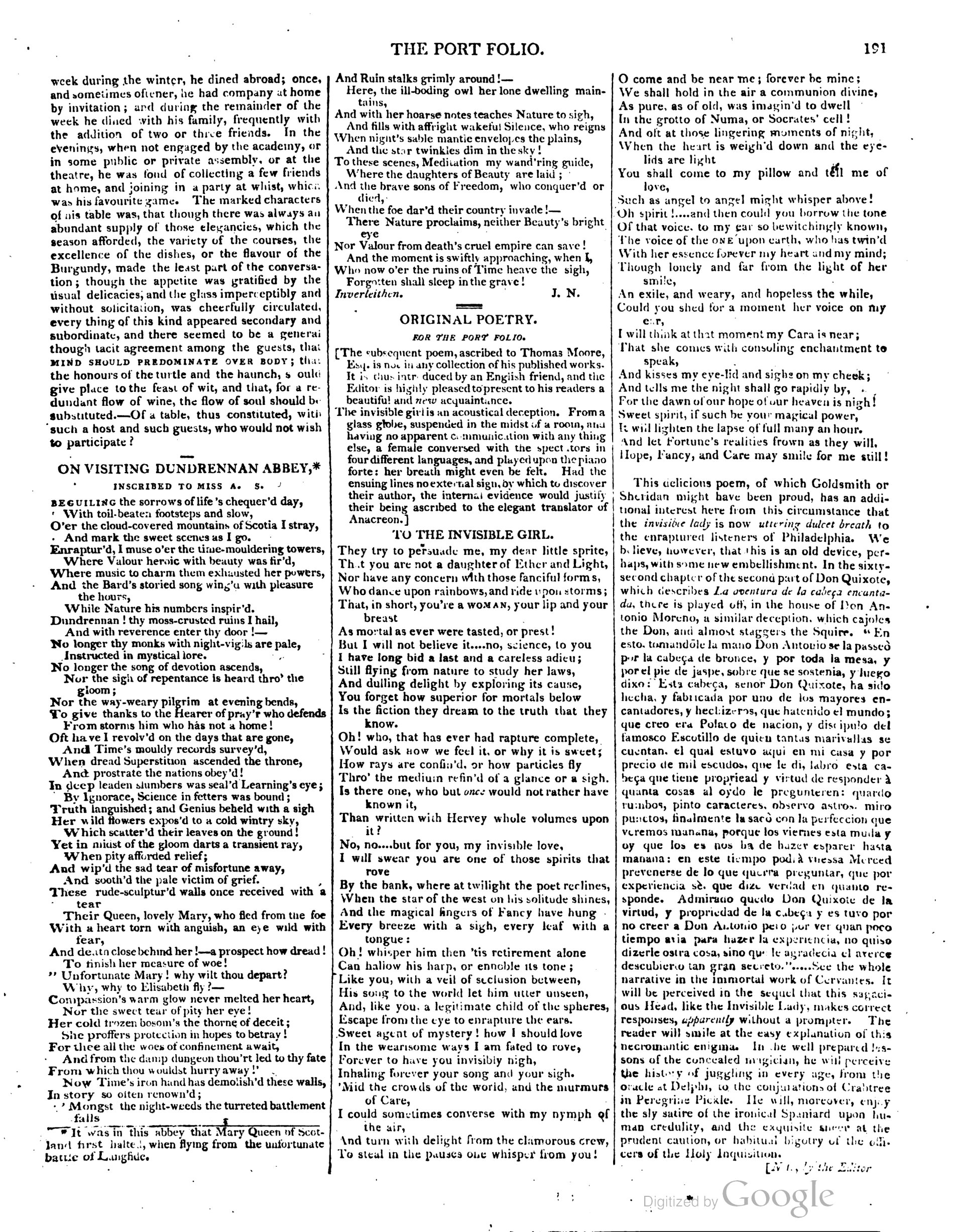
To the Invisible Girl
The Poetical Register, and Repository of Fugitive Poetry, F. and C. Rivington, London 1802, pp. 195-197.
1 volume available
In the Poetical Register for 1802 Thomas Moore, signing "T. M.", published "To the Invisible Girl", a poem addressed to the voice that spoke from the glass globe exhibited by Charles Rouy in Leicester Square. The poet refuses to believe that the voice belongs to a real woman, preferring "the fiction they dream to the truth that they know", and imagines the invisible nymph as a model for the poet who sings to the world unseen and as a nightly visitor who might lend him the voice of his distant beloved. An editorial footnote describes the "acoustical Deception": a woman conversing in four languages and playing the piano from a suspended glass globe. In June 1804 Joseph Dennie's Port Folio reprinted the poem in Philadelphia with a few variants, noting that the "invisible lady" was then delighting Philadelphia audiences, and compared the trick to the enchanted head of Don Quixote (II, 62). Moore later collected the poem in his Epistles, Odes, and Other Poems (1806). Full transcription and Italian translation.
Language
English
